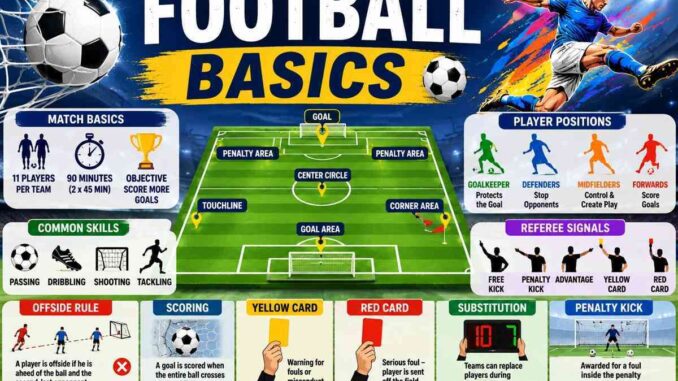
Football Positions are the foundation of every successful football team. Each player has specific responsibilities that contribute to defense, possession, creativity, and goal scoring. Understanding football positions helps players, coaches, and fans analyze matches more effectively. This guide explains every major football position, including goalkeepers, defenders, midfielders, forwards, wingers, and specialized modern roles used in today’s game.
What Are Football Positions?
Football positions refer to the designated areas and responsibilities assigned to players on the field. Each position plays a unique role in helping the team attack, defend, and maintain balance throughout the match.
Modern football uses specialized player roles that require technical skills, tactical awareness, physical fitness, and decision-making abilities.
Main Football Position Categories
| Position Group | Primary Objective |
|---|---|
| Goalkeeper | Protect the goal |
| Defenders | Stop attacks |
| Midfielders | Control possession |
| Forwards | Score goals |
Understanding these categories is essential for learning football tactics and player development.
Complete Football Positions Chart
A football team consists of eleven players organized into various positions.
Standard Football Positions
| Position | Abbreviation | Main Role |
|---|---|---|
| Goalkeeper | GK | Prevent goals |
| Center Back | CB | Central defense |
| Full Back | FB | Wide defense |
| Wing Back | WB | Attack and defend |
| Defensive Midfielder | CDM | Shield defense |
| Central Midfielder | CM | Control midfield |
| Attacking Midfielder | CAM | Create chances |
| Winger | LW/RW | Attack from wide areas |
| Striker | ST | Score goals |
| Second Striker | SS | Support attack |
This football positions chart provides a quick overview of player responsibilities.
Also Read: Football Basics Rules, Field Dimensions, Scoring, Offside, Cards, and Match Regulations
Goalkeeper Position Explained
The goalkeeper is the most specialized position in football.
Unlike other players, goalkeepers can use their hands within the penalty area.
Goalkeeper Responsibilities
1. Shot Stopping
Goalkeepers prevent opponents from scoring by saving shots.
2. Positioning
Good positioning allows goalkeepers to cover more of the goal.
3. Distribution
Modern goalkeepers start attacks through passing and ball distribution.
4. Communication
Goalkeepers organize defenders and provide instructions during play.
5. Aerial Control
They claim crosses and high balls inside the penalty area.
Essential Goalkeeper Skills
- Reflexes
- Agility
- Handling
- Communication
- Decision-making
- Leadership
- Positioning
The goalkeeper often serves as the team’s last line of defense.
Defender Roles in Football
Defenders protect the goal and stop opposition attacks.
Modern defenders contribute both defensively and offensively.
Center Back (CB)
Center backs operate in central defensive areas.
Responsibilities
- Blocking shots
- Winning aerial duels
- Marking strikers
- Organizing defense
- Clearing danger
Center backs are usually strong, disciplined, and physically dominant.
Full Back (LB/RB)
Full backs defend wide areas of the pitch.
Responsibilities
- Defending wingers
- Supporting attacks
- Delivering crosses
- Tracking runners
- Maintaining width
Modern full backs frequently contribute to attacking play.
Wing Back (LWB/RWB)
Wing backs combine defensive and attacking responsibilities.
Responsibilities
- Covering entire flank
- Crossing into the penalty area
- Supporting defense
- Creating attacking opportunities
This role requires exceptional stamina and work rate.
Midfielder Roles and Responsibilities
Midfielders are often considered the engine of the team.
They connect defense and attack while controlling possession.
Defensive Midfielder Guide
The defensive midfielder protects the defensive line and controls transitions.
Defensive Midfielder Responsibilities
1. Breaking Up Attacks
They intercept passes and disrupt opposition movement.
2. Protecting Defenders
Defensive midfielders provide additional defensive cover.
3. Winning Possession
They recover loose balls and initiate attacks.
4. Controlling Tempo
They help dictate the pace of play.
5. Maintaining Structure
They keep the team organized defensively.
Key Defensive Midfielder Skills
- Tackling
- Positioning
- Passing
- Vision
- Discipline
- Tactical awareness
Defensive midfielders are crucial in modern football systems.
Central Midfielder Roles and Responsibilities
Central midfielders influence both attacking and defensive phases.
They often cover the most distance during matches.
Central Midfielder Responsibilities
1. Ball Distribution
Moving possession efficiently around the field.
2. Linking Play
Connecting defenders and attackers.
3. Maintaining Possession
Helping the team control the game.
4. Supporting Attacks
Joining offensive movements when needed.
5. Defensive Contribution
Pressing opponents and recovering possession.
Important Central Midfielder Skills
- Passing accuracy
- Vision
- Endurance
- Ball control
- Decision-making
- Awareness
Central midfielders often dictate match rhythm.
Attacking Midfielder vs Central Midfielder
Many beginners confuse these two football positions.
Although both operate in midfield, their objectives differ significantly.
Attacking Midfielder (CAM)
An attacking midfielder focuses primarily on creating scoring opportunities.
Responsibilities
- Creating assists
- Making key passes
- Supporting strikers
- Finding attacking spaces
- Scoring goals
Central Midfielder (CM)
A central midfielder balances attacking and defensive duties.
Responsibilities
- Controlling possession
- Distributing passes
- Supporting defense
- Managing tempo
- Maintaining structure
Attacking Midfielder vs Central Midfielder Comparison
| Feature | Attacking Midfielder | Central Midfielder |
|---|---|---|
| Position | Advanced midfield | Central midfield |
| Main Focus | Creativity | Balance |
| Goal Contribution | High | Moderate |
| Defensive Duties | Lower | Higher |
| Key Skill | Vision | Versatility |
Both positions are essential for effective midfield play.
Winger Role in Modern Football
The winger position has evolved significantly in modern football.
Traditional wingers stayed wide, while modern wingers often move inside attacking areas.
Winger Responsibilities
1. Creating Width
Stretching opposition defenses.
2. Delivering Crosses
Providing service to strikers.
3. Dribbling Defenders
Creating one-on-one opportunities.
4. Scoring Goals
Modern wingers contribute heavily to goal scoring.
5. Pressing Opponents
Supporting defensive efforts.
Key Winger Skills
- Speed
- Acceleration
- Dribbling
- Crossing
- Finishing
- Creativity
Wingers are among the most exciting players to watch.
Forward Position Explained
Forwards are primarily responsible for scoring goals.
They operate closest to the opponent’s goal.
Striker (ST)
The striker serves as the team’s main goal scorer.
Responsibilities
- Finishing chances
- Holding up play
- Attacking crosses
- Making runs behind defenders
- Creating scoring opportunities
Second Striker (SS)
The second striker supports the main forward.
Responsibilities
- Linking midfield and attack
- Creating chances
- Finding spaces
- Assisting goals
- Scoring from deeper positions
Essential Forward Skills
- Finishing
- Movement
- Positioning
- Composure
- Strength
- Decision-making
Successful forwards consistently convert opportunities into goals.
Best Football Positions for Beginners
Choosing the right position helps new players develop confidence and skills.
Recommended Positions for Beginners
Full Back
Teaches defensive fundamentals and positioning.
Central Midfielder
Develops passing, awareness, and overall football understanding.
Winger
Improves dribbling, pace, and attacking confidence.
Defensive Midfielder
Builds tactical discipline and positioning skills.
Goalkeeper
Suitable for players with strong reflexes and concentration.
Beginner Position Comparison
| Position | Difficulty Level |
|---|---|
| Full Back | Easy |
| Winger | Easy |
| Central Midfielder | Moderate |
| Defensive Midfielder | Moderate |
| Striker | Moderate |
| Goalkeeper | Advanced |
Beginners should focus on learning fundamentals before specializing.
How Football Positions Have Changed in Modern Football
Modern football emphasizes flexibility and versatility.
Emerging Trends
- Inverted full backs
- Ball-playing defenders
- False nine forwards
- Pressing forwards
- Advanced goalkeepers
- Hybrid midfielders
Players increasingly perform multiple responsibilities within tactical systems.
Key Skills Required for Every Football Position
Regardless of position, all players benefit from developing core football abilities.
Technical Skills
- Passing
- Ball control
- Shooting
- Dribbling
- Tackling
Physical Skills
- Speed
- Strength
- Endurance
- Agility
- Balance
Mental Skills
- Decision-making
- Awareness
- Communication
- Leadership
- Tactical understanding
These skills support performance across all football positions.
Conclusion
Football Positions define how teams operate on the field. From goalkeepers protecting the net to defenders stopping attacks, midfielders controlling possession, and forwards scoring goals, every position plays a critical role in team success. Understanding goalkeeper responsibilities, defender roles, midfielder functions, winger duties, and attacking positions helps players improve performance while giving fans a deeper appreciation of football tactics and strategy.
FAQs
1. What are the main football positions?
The main football positions are goalkeeper, defender, midfielder, and forward.
2. What does a goalkeeper do?
A goalkeeper prevents goals, organizes defenders, and starts attacks through distribution.
3. What is the role of a defender in football?
Defenders stop attacks, mark opponents, and protect the goal.
4. What is the difference between an attacking midfielder and a central midfielder?
Attacking midfielders focus on creativity and goal chances, while central midfielders balance attack and defense.
5. What does a winger do in modern football?
Wingers create width, beat defenders, provide crosses, and contribute goals.
6. Which football position scores the most goals?
Strikers typically score the highest number of goals.
7. What is a defensive midfielder?
A defensive midfielder protects defenders and helps regain possession.
8. Which football position is best for beginners?
Full back, winger, and central midfielder are often suitable positions for beginners learning the game.
Leave a Reply