
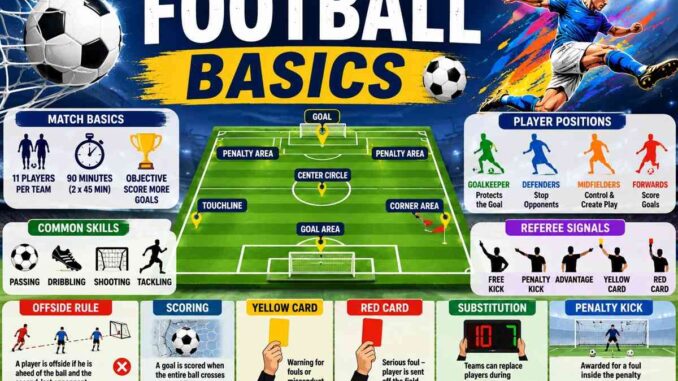
Football Basics are essential for anyone who wants to understand the world’s most popular sport. Whether you are a beginner, student, player, coach, sports blogger, or football fan, learning the fundamental rules of football helps you enjoy matches and understand the game’s tactics. This guide explains how football is played, football rules, field dimensions, scoring systems, referee signals, offside laws, substitution rules, and penalty regulations.
What Is Football and How is It Played?
Football is a team sport played between two teams consisting of eleven players each. The objective is to score more goals than the opposing team within the official match duration.
Players primarily use their feet to control, pass, and shoot the ball. The goalkeeper is the only player allowed to use hands within the penalty area.
Basic Football Objectives
- Score goals
- Maintain possession
- Defend effectively
- Create scoring opportunities
- Prevent opposition attacks
- Win the match
Football combines technical skills, teamwork, tactical awareness, and physical fitness.
Also Read: Ultimate Football Guide Players, Leagues, Tactics, History, and Latest Updates
Why Learning Football Basics Matters
Understanding football fundamentals helps players and fans analyze matches more effectively.
Benefits of Learning Football Basics
- Better understanding of match decisions
- Improved tactical awareness
- Enhanced football knowledge
- Easier interpretation of referee decisions
- Better player development
- Improved coaching insights
- Greater enjoyment while watching matches
Complete Football Rules Explained
Football follows a standardized set of laws used worldwide.
1. Two Teams Compete
Each team consists of:
- 11 players
- 1 goalkeeper
- Outfield players
The team with more goals wins.
2. Match Starts with Kick-Off
The game begins from the center circle.
Kick-offs also restart play after goals are scored.
3. Ball Must Stay Within Boundaries
Play continues as long as the ball remains inside the touchlines and goal lines.
The referee stops play when the ball completely crosses these boundaries.
4. Fouls Result in Punishments
Common fouls include:
- Tripping
- Pushing
- Handball
- Holding opponents
- Dangerous tackles
Referees award free kicks or penalties depending on the location of the foul.
5. Referee Has Final Authority
The referee controls the match and enforces football laws.
Responsibilities include:
- Applying rules
- Issuing cards
- Awarding penalties
- Managing player behavior
Football Field Dimensions and Markings
Football fields follow specific international standards.
Standard Football Field Measurements
| Field Component | Measurement |
|---|---|
| Length | 100–110 meters |
| Width | 64–75 meters |
| Goal Width | 7.32 meters |
| Goal Height | 2.44 meters |
| Penalty Area Depth | 16.5 meters |
| Center Circle Radius | 9.15 meters |
| Penalty Spot Distance | 11 meters |
Important Football Field Markings
Center Circle
Used for kick-offs and match restarts.
Penalty Area
The goalkeeper can handle the ball inside this zone.
Goal Area
Used for goal kicks and goalkeeper positioning.
Penalty Spot
The location where penalty kicks are taken.
Corner Arc
Used for corner kicks.
Understanding these markings improves match awareness and tactical understanding.
Football Match Duration Explained
One of the most common questions among beginners concerns match length.
Standard Football Match Time
A football match consists of:
- First Half: 45 minutes
- Half-Time Break: 15 minutes
- Second Half: 45 minutes
Total Playing Time
- 90 minutes
- Additional stoppage time added by referee
Extra Time
Certain knockout matches require additional periods.
Extra Time Structure
- Two periods
- 15 minutes each
- Total: 30 minutes
If scores remain level, penalties may determine the winner.
How Football Scoring Works ?
Goals determine match outcomes.
When Is a Goal Awarded?
A goal is scored when:
- The entire ball crosses the goal line
- The ball passes between goalposts
- The ball goes beneath the crossbar
Even a small portion of the ball remaining on the line means no goal is awarded.
Types of Goals
Open Play Goal
Scored during normal gameplay.
Header Goal
Scored using the head.
Penalty Goal
Scored from a penalty kick.
Free Kick Goal
Scored directly from a free kick.
Own Goal
Accidentally scored into a team’s own net.
Football Referee Signals Explained
Referee signals help players and fans understand decisions.
Common Referee Signals
Direct Free Kick
Referee points toward the offending team’s goal.
Indirect Free Kick
Referee raises one arm vertically.
Penalty Kick
Referee points directly to the penalty spot.
Advantage
Referee extends both arms forward.
Yellow Card
Referee displays a yellow card as a warning.
Red Card
Referee displays a red card, resulting in player dismissal.
Learning referee signals helps fans interpret matches more accurately.
Yellow Card vs Red Card in Football
Disciplinary cards maintain order and fair play.
Yellow Card
A yellow card serves as an official warning.
Reasons for Yellow Cards
- Unsporting behavior
- Persistent fouls
- Delaying play
- Dissent
- Simulation
Two yellow cards result in a red card.
Red Card
A red card removes a player from the match.
Reasons for Red Cards
- Violent conduct
- Serious foul play
- Spitting
- Denying a clear goal opportunity
- Offensive behavior
The dismissed player cannot be replaced.
Yellow Card vs Red Card Comparison
| Feature | Yellow Card | Red Card |
|---|---|---|
| Warning | Yes | No |
| Player Continues | Yes | No |
| Match Suspension | Possible | Usually |
| Immediate Dismissal | No | Yes |
| Team Loses Player | No | Yes |
Football Offside Rule Explained
The offside rule is one of football’s most important and misunderstood regulations.
What Is Offside?
A player is offside when:
- Positioned nearer to the opponent’s goal line
- Ahead of both the ball and second-last defender
- Actively involved in play
Being in an offside position alone is not an offense.
The player must influence play.
Situations That Are Not Offside
Players cannot be offside directly from:
- Goal kicks
- Throw-ins
- Corner kicks
These exceptions are important tactical elements.
Why the Offside Rule Exists
The offside rule prevents attackers from remaining near the goal waiting for easy scoring opportunities.
It encourages:
- Tactical play
- Team movement
- Fair competition
Football Substitution Rules
Modern football allows teams to replace players during matches.
Why Substitutions Are Used
Coaches make substitutions to:
- Change tactics
- Replace injured players
- Rest fatigued players
- Strengthen attack
- Improve defense
Current Football Substitution Rules
Most major competitions allow:
- Five substitutions
- Multiple substitution windows
- Additional substitutions in extra time
Competition-specific regulations may vary.
Strategic Importance of Substitutions
Effective substitutions can:
- Change match momentum
- Improve energy levels
- Create tactical advantages
- Protect leads
- Increase attacking options
Football Penalty Rules Guide
Penalties often decide crucial matches.
What Is a Penalty Kick?
A penalty kick is awarded when a defending player commits a direct free-kick offense inside the penalty area.
Penalty Kick Procedure
Key Requirements
- Ball placed on penalty spot
- Goalkeeper remains on goal line
- Other players remain outside penalty area
- Referee signals before kick
Common Penalty Offenses
Penalties may be awarded for:
- Handball
- Tripping
- Holding
- Pushing
- Dangerous challenges
Penalty Shootouts
When knockout matches remain tied after extra time:
Shootout Format
- Five kicks per team
- Alternate attempts
- Sudden death if tied
Penalty shootouts often create some of football’s most dramatic moments.
Essential Football Terms Every Beginner Should Know
Common Football Vocabulary
| Term | Meaning |
|---|---|
| Goal | Ball crosses goal line |
| Assist | Final pass before goal |
| Clean Sheet | No goals conceded |
| Hat-Trick | Three goals by one player |
| Corner Kick | Restart from corner |
| Free Kick | Awarded after foul |
| Offside | Positional offense |
| Extra Time | Additional playing period |
Understanding football terminology improves game analysis and fan engagement.
Key Football Skills for Beginners
Technical Skills
- Passing
- Dribbling
- Shooting
- Ball Control
- Heading
- Tackling
Physical Skills
- Speed
- Agility
- Endurance
- Balance
- Strength
Tactical Skills
- Positioning
- Decision Making
- Awareness
- Communication
- Teamwork
These skills form the foundation of football development.
These terms help connect core football concepts and improve topic understanding.
Conclusion
Football Basics provide the foundation for understanding how the world’s most popular sport operates. From match duration and field dimensions to scoring rules, offside laws, substitutions, yellow cards, red cards, and penalties, every rule contributes to making football fair, competitive, and exciting. Whether you are a beginner learning the game or a fan seeking deeper knowledge, mastering these football fundamentals will help you appreciate matches, players, tactics, and competitions at a much higher level.
FAQs
1. What are the basic rules of football?
Football is played between two teams of eleven players aiming to score more goals than the opponent.
2. How long does a football match last?
A standard football match lasts 90 minutes plus stoppage time.
3. What is the offside rule in football?
Offside prevents attackers from gaining an unfair advantage near the opponent’s goal.
4. How many players are allowed on a football team?
Each team fields eleven players, including one goalkeeper.
5. What is the difference between a yellow card and a red card?
A yellow card is a warning, while a red card results in immediate dismissal.
6. How are goals scored in football?
A goal is scored when the entire ball crosses the goal line between the posts and under the crossbar.
7. How many substitutions are allowed in football?
Most major competitions currently allow five substitutions during a match.
8. What happens if a knockout match ends in a draw?
The match may proceed to extra time and then a penalty shootout if necessary.
Leave a Reply